



The output of a go-to-market system is set by its constraint, the one stage that currently limits how many profitable customers the business can add. Spend added anywhere else buys more activity and more cost, and the same number of customers. The science of scaling is finding that constraint, relieving it, then pushing spend until the evidence says the constraint has moved or a guardrail is close.
Why is a good month the wrong reason to scale?
Because a short run of encouraging results says nothing about whether the wider system can turn more spend into more customers.
Almost every client we work with asks some version of the same questions. Can we scale this? How much can we spend? What should we do next?
The questions often arrive at a particular moment. A campaign has had a good month. More budget has become available. A new market, channel or competitive opportunity has appeared. There is a sense that the company should move before the moment passes.
Those opportunities can be real, but they should not dictate the decision. A scaling plan built on a moment of inspiration, or a short run of encouraging results, is a bet. A durable plan starts with a simpler question: what is the single biggest thing the company could change to increase the output of its wider marketing system?
Answering that requires a wider view than the campaigns. You need to understand how demand becomes an opportunity, how opportunities become customers, how much capacity each stage has and whether those customers create enough gross profit to justify what it cost to acquire them. This is the science behind scaling. It is an understanding of the system, the economics that support it and the constraint that currently limits its output.
That understanding creates room to move. A company that knows where additional investment will help, and where it will create more cost, can operate with more confidence. It can also stop relying only on what is already tried and tested. If the overall model is understood, a team can make a bet on brand, sponsorship, events or a new channel without demanding that every pound returns through a short-term attribution loop. It can take more risk because the boundaries of that risk are visible. Without that understanding, "spend more" is a leap of faith. With it, scaling becomes a deliberate decision.
The simple maths makes this easier to see. Imagine a business generates 100 accepted leads and converts 10% of them into opportunities. It creates 10 opportunities. If it doubles the number of leads to 200 but conversion falls to 5%, it still creates 10 opportunities.
Marketing can report 100% growth in lead volume. The ad platforms can report more conversions. The team can be busier than ever. But the business has paid for twice as much input and received exactly the same output.
What limits marketing output? The Theory of Constraints
The output of any system is limited by its constraint, an idea developed by Eliyahu Goldratt as the Theory of Constraints and made widely known through his book The Goal. Goldratt was writing about manufacturing, but the central idea travels well: relieve the constraint and output rises; improve anything else and it does not.
If four machines on a production line can process 200 units an hour, but one can only process 100, the line does not produce 200 units. It produces 100. Making one of the faster machines even faster might improve its individual performance. It does not increase the output of the line.
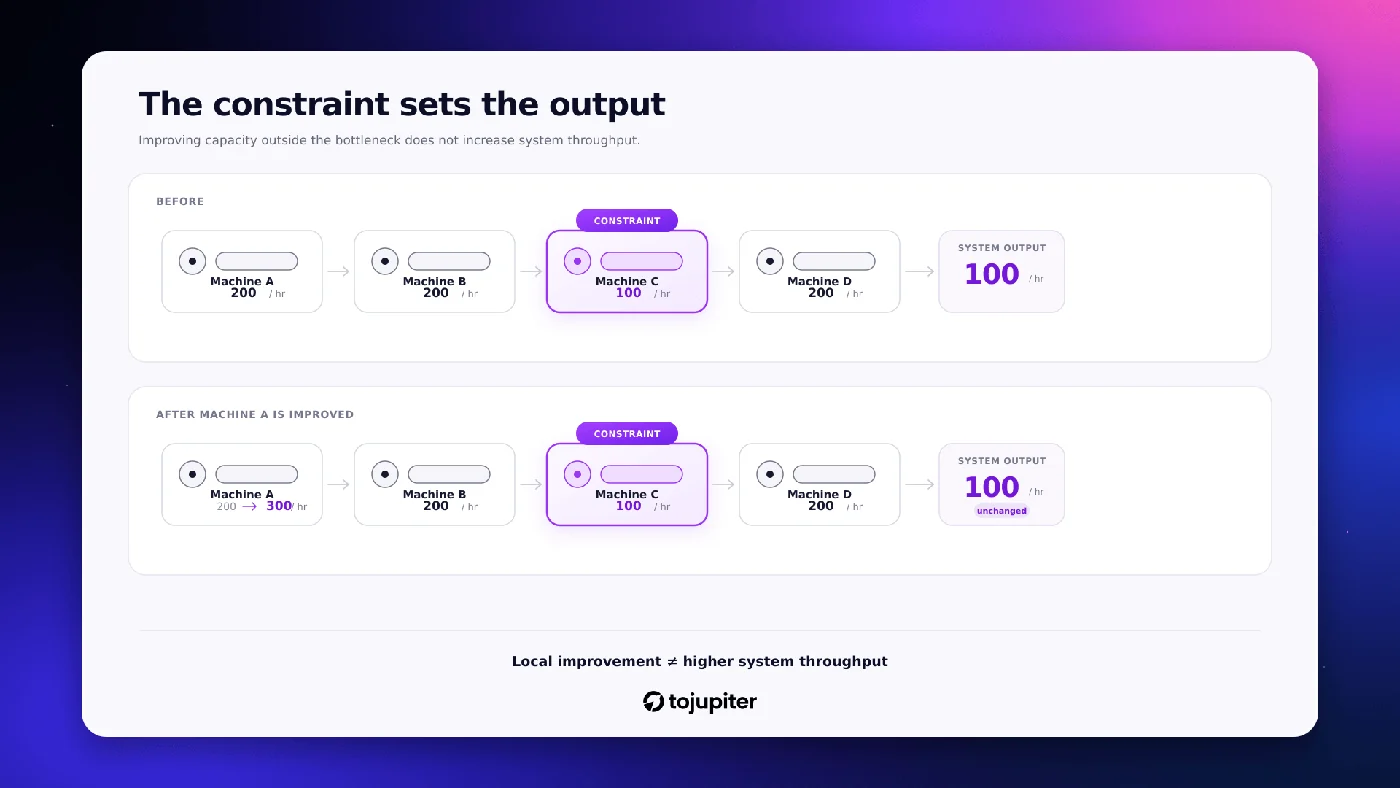
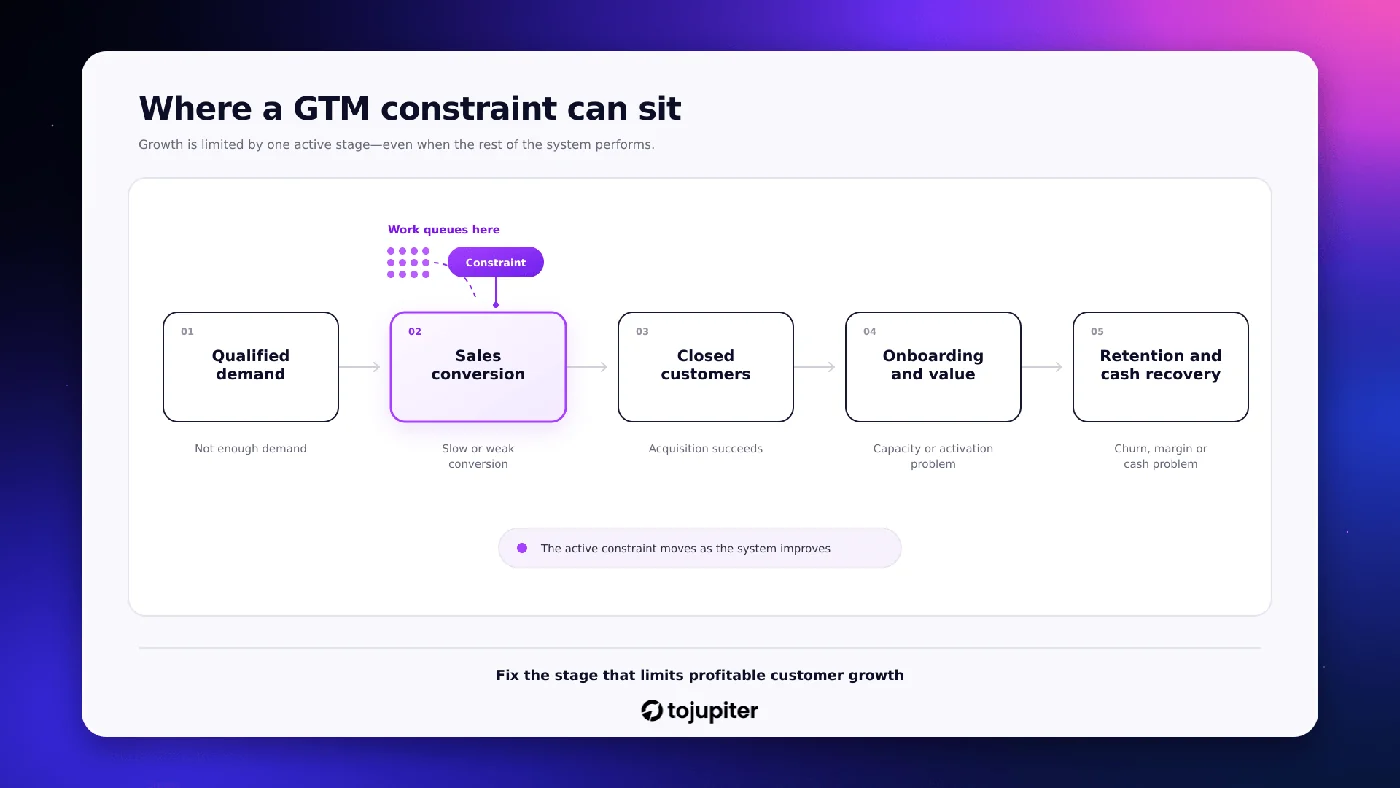
A marketing funnel behaves in a similar way. Demand moves through marketing, sales, onboarding and eventually into a customer getting enough value to remain a customer. Each part depends on the one before it, and each part has a limit.
A sales process is not a factory, of course. Prospects differ from one another, conversion is uncertain and the effects of marketing can take time to appear. As a way of deciding where to focus, though, the comparison earns its keep. Increasing the capacity of one part does not guarantee more customers if another part cannot handle the extra flow.
Sometimes that limit is demand. The sales team has capacity, conversion is healthy, customers are staying, and the business simply does not create enough qualified opportunities. In that situation, more marketing can increase the number of customers acquired.
Sometimes the limit is conversion. Leads arrive, but follow-up is slow, qualification is inconsistent, opportunities stall or the win rate is poor. Adding more leads to that system creates a larger pile of unworked or badly worked demand.
Sometimes the limit comes after the sale. The company can acquire customers, but onboarding takes too long, service costs are too high or customers leave before their acquisition cost has been recovered. The funnel looks healthy until you include the part where the customer has to create economic value.
The constraint can even be cash. A company may have acceptable long-term customer economics and still be unable to fund the gap between paying to acquire a customer and collecting enough gross profit to recover that money.
How do you find the constraint in a B2B SaaS funnel?
Look for the damage: where leads or deals are accumulating, where stages take longer than they used to, where the team feels permanently stretched, and where the largest amount of potential revenue is being lost. Most importantly, ask what would improve the result for the whole business rather than one departmental dashboard.
The constraint is not automatically the stage with the lowest conversion rate. A low conversion rate might be normal for that stage. It might be difficult to change, or it might have little effect on total revenue. The real question is where a practical improvement would release the most additional customers or gross profit.
How do you relieve a constraint before adding budget?
Make better use of the constrained stage before buying more of it. Goldratt's method gives a sensible order for what happens next: identify the constraint, then get more from the resource already in place.
If sales capacity is the constraint, that might mean removing poor-fit leads from a rep's queue, improving routing or taking administrative work away from the people who need to speak to customers. If onboarding is the constraint, it might mean fixing scheduling, documentation or handoffs before hiring another implementation manager.
This matters because businesses often jump straight from finding a problem to buying more capacity. More people or more technology may eventually be necessary. Find out how much usable capacity already exists first. Otherwise the company spends more without fixing the process that made the original resource ineffective.
Why would marketing deliberately produce fewer leads?
Because paying to create a queue destroys value the moment the queue forms. The next step of Goldratt's method is more counterintuitive: the rest of the system has to be aligned around the constraint.
For marketing, that can mean producing fewer leads for a period, narrowing the audience or changing the success metric from raw volume to opportunities the sales team can genuinely process. That can look like marketing slowing down. In reality, it stops the company paying to create a queue.
Queues are particularly damaging in a sales process because leads do not sit there unchanged. Interest fades, competitors respond and the context that caused someone to enquire moves on. A study of 1.25 million online sales leads published by Harvard Business Review found that companies attempting contact within an hour were nearly seven times as likely to qualify a lead as those that waited even an hour longer. The study is old, and the exact number should not be treated as a universal rule, but the underlying point holds: delay destroys some of the value marketing worked to create.
Once the constrained part of the system is being used properly, the business can decide whether to add resource. That might mean more media spend, another salesperson, more implementation capacity, automation or a product change that removes a recurring objection.
Then the process starts again. If sales conversion improves, onboarding might become the new limit. If onboarding improves, cash payback might become the next concern. The reward for fixing a constraint is usually discovering the next one.
That explains where to invest. It does not yet explain how far to push. This is where guardrails matter.
What guardrails should govern marketing spend?
Five: CAC payback, marginal CAC, cash, customer quality and capacity. A constraint and a guardrail do different jobs. The constraint tells you where additional effort counts most. A guardrail is a boundary the company does not want to cross while applying that effort.
What is an acceptable CAC payback period?
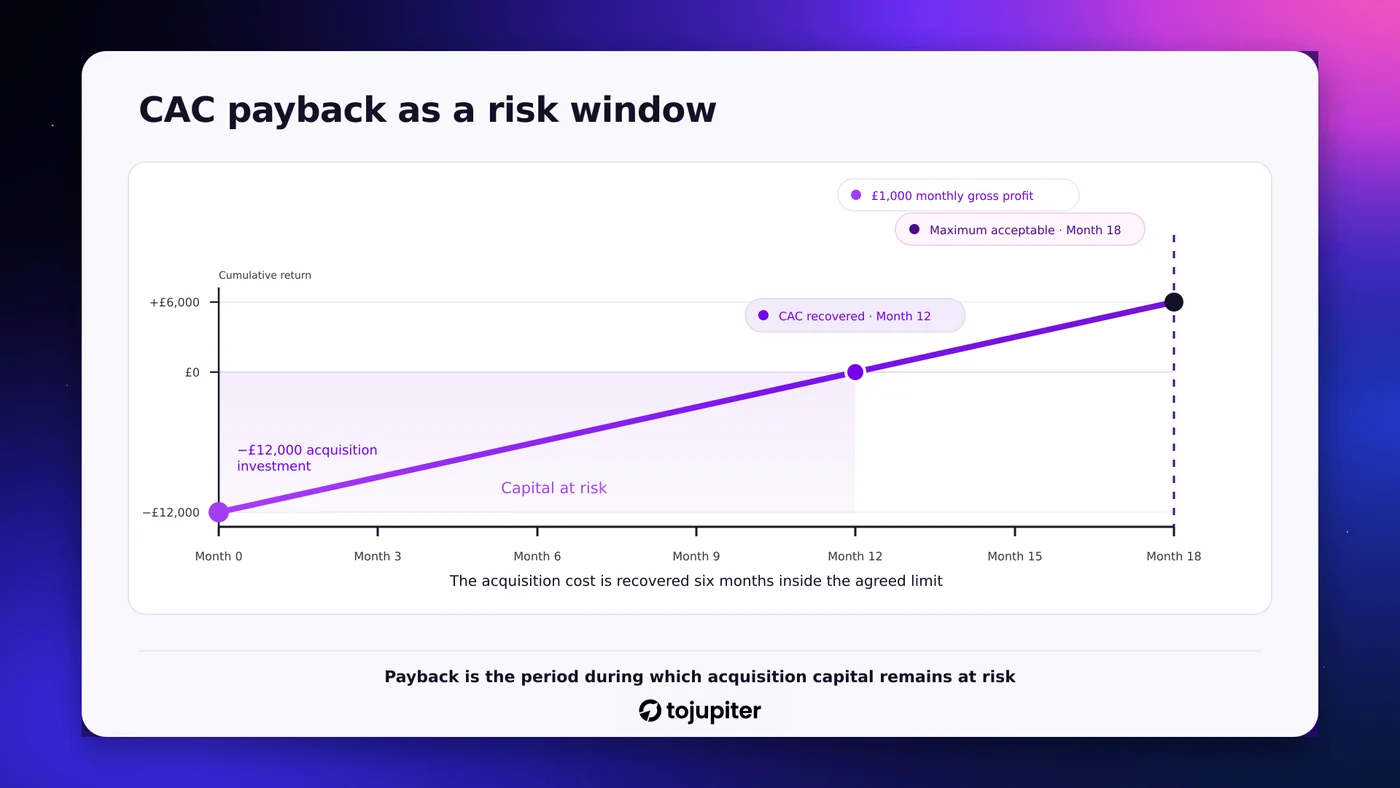
The longest one the business has agreed it can fund, given its margin, retention and available capital. If it costs £12,000 to acquire a customer and that customer contributes £1,000 in gross profit each month, the acquisition cost takes 12 months to recover. If the company has agreed that 18 months is the maximum acceptable payback, it has room to invest more. If the next group of customers pushes payback beyond that point, it needs to hold or investigate.
There is no universal number that every business should copy. An enterprise software company with large annual contracts and strong retention can tolerate a longer payback period than a small-business product with monthly contracts and higher churn. The right limit depends on gross margin, customer quality, payment terms and the amount of capital available.
What is marginal CAC and why does it matter?
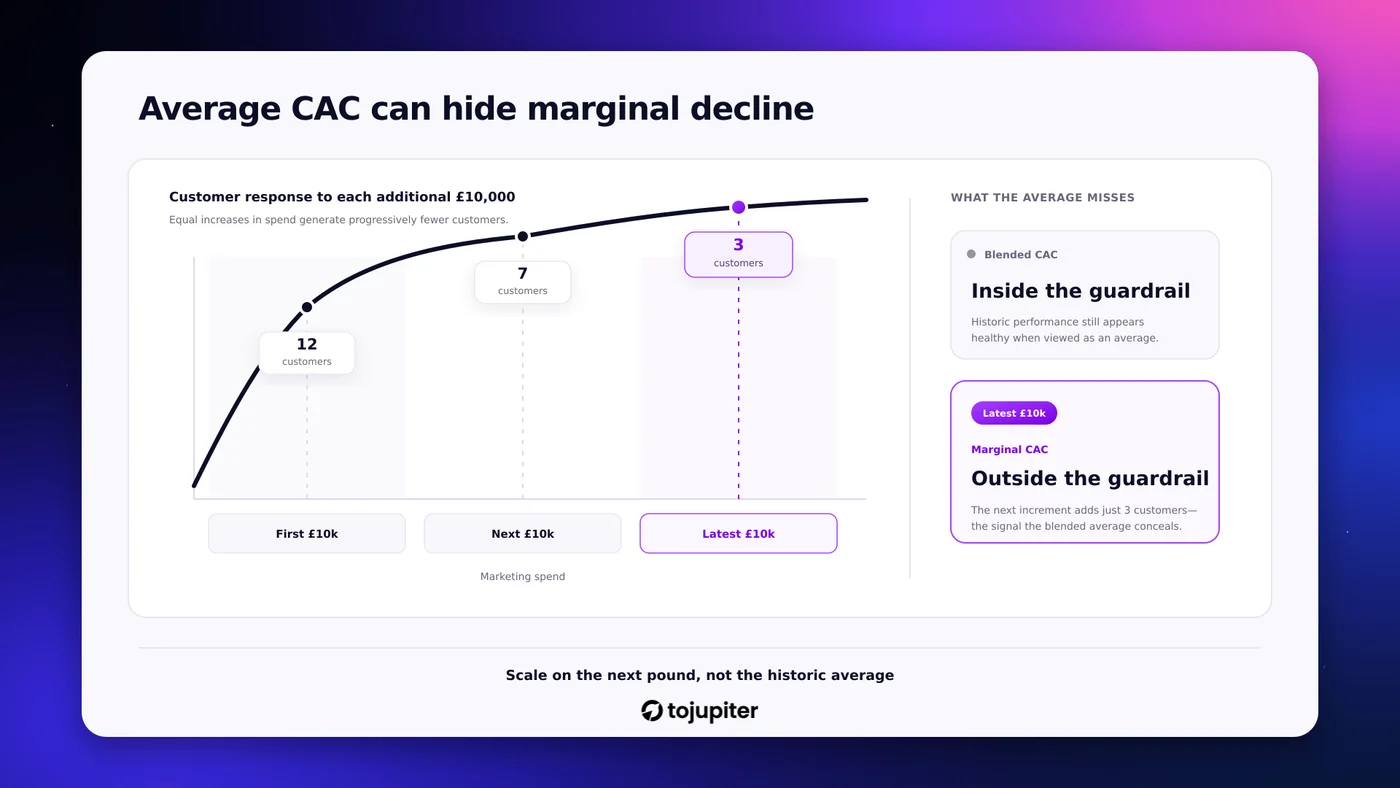
Marginal CAC is the cost of the customers created by the most recent increase in spend, and it is the number that decides whether the next increase makes sense.
The distinction from blended CAC matters because marketing channels saturate. The first £10,000 spent in a channel might reach the easiest part of the market. The next £10,000 may reach people who are more expensive to convert. A blended CAC can remain healthy for some time even when the most recent block of spend is no longer attractive.
So a scaling decision should look at the margin: how much additional money did we spend, and how many additional customers did that particular increase create? Historical efficiency tells you how the system has performed. Marginal efficiency tells you whether pushing further still makes sense.
Cash: can the business fund the wait?
The third guardrail is cash. A good-looking return does not help if the business runs out of money while waiting for it.
This is easy to miss in SaaS because revenue, profit and cash do not always arrive at the same time. A customer paying annually in advance creates a different cash position from one paying monthly. Implementation costs, payment delays and churn before renewal also change how long acquisition capital is genuinely at risk.
Customer quality: does the new revenue survive?
The fourth guardrail is customer quality. New revenue needs to survive long enough to justify what it cost to acquire.
That means following each group of new customers through activation, retention and expansion. If acquisition rises while onboarding takes longer, support demand increases or early churn gets worse, the company may be borrowing apparent growth from a future quarter. Customer acquisition has not scaled if customer value creation has not scaled with it.
Capacity: can the team absorb the next increase?
The final guardrail is capacity. Can sales, onboarding and customer success absorb the next increase without response times, stage duration or service quality deteriorating?
No team needs to sit half-empty in case demand arrives. The point is that a system with no spare capacity has no ability to absorb normal variation. If every salesperson is permanently at their theoretical limit, a busy week is enough to create a backlog. Once the backlog forms, response times slow and conversion begins to fall. The business can look highly utilised while becoming less productive.
Which numbers should make the scaling decision?
Customers, gross profit, payback, retention and cash. Platform metrics prompt a closer look; they should never make the investment decision on their own.
CPM, CPC, response time and stage conversion can act as early warnings. They help explain whether the model may be drifting, and they move fast enough to be watched weekly.
The guardrails work best when they are agreed before the spending decision. The CMO, CFO and CEO should know what would give them confidence to continue, what would make them hold the current level and what would cause them to reduce or reallocate spend. That creates a much calmer way to scale. Instead of arguing about a bad week after it happens, the company has already decided which movements are early warnings and which are genuine breaches.
The same applies to attribution. It is useful to know where a lead interacted with the company, but attributed revenue is not necessarily revenue that activity created. Wherever possible, ask what changed because of the additional spend. That can be tested through holdouts, geographic experiments or simpler comparisons between well-matched groups. In lower-volume B2B companies the evidence will rarely be perfect, but the question beats allowing every channel to award itself credit.
How do you put this into practice? The constraint-guardrail loop
Model the whole journey, find the tightest stage, use it better, align the rest of the system around it, then add resource and measure, all inside the agreed guardrails. We call this the constraint-guardrail loop.
In practice, start with a simple model of the whole journey. How much enters each stage? How much leaves? How long does it take? What can the team realistically process? What does an acquired customer contribute after the cost of serving them? How long does it take for the cash to come back?
From there, identify the stage that is placing the tightest limit on additional customers. Use the existing resource better. Align the rest of the system around it. Only then add meaningful spend or capacity.
Increase spend in steps large enough to create a signal but small enough that a mistake is recoverable. Watch the leading indicators as the increase happens, then judge the resulting group of customers against the financial and customer-quality guardrails. Continue when the model holds. Pause when it drifts. Reduce or reallocate when a genuine boundary is crossed.
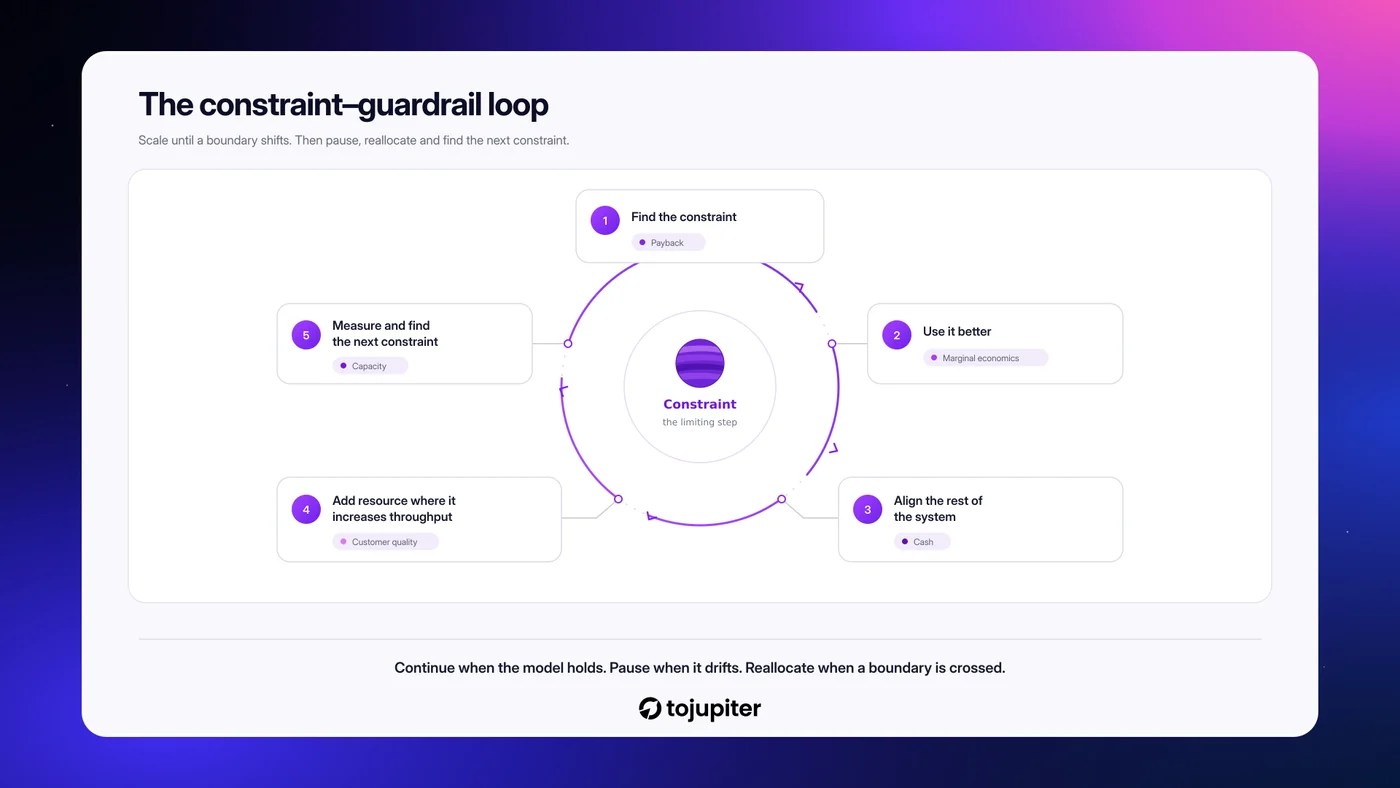
Applied to a business where lead volume is rising but opportunity volume is not, the loop means resisting the urge to launch another demand campaign. The immediate work is to understand why accepted leads have stopped becoming opportunities. Look at response time, routing, qualification, rep workload and the amount of work already sitting at that stage.
If that process can be repaired, the existing lead volume may already be enough to create significantly more pipeline. If the team is still at capacity once the process is working properly, there is a defensible case for adding resource. Only once that stage can convert the additional demand does it make sense to increase marketing again.
Guardrails are permission to be aggressive
Guardrails can sound like a conservative idea. Their real value is the opposite. They give a company permission to be more aggressive because everyone understands the conditions under which spending remains safe.
Treat budget as an output of the economics and capacity of the business, rather than a number handed to marketing at the start of the year. If the next customer remains attractive, if cash can support the delay, and if the rest of the company can absorb the work, then spending more is a sound decision. Moving too slowly can be the greater risk.
The science of scaling is finding what currently limits profitable customer acquisition, relieving it, and pushing until the evidence says the constraint has moved or a guardrail is close. The blocker will not always be more leads. Quite often, the leads are simply where the problem becomes visible.


