


ABM fails at the account, not the ad. Most B2B SaaS teams launch account-based marketing by uploading a company list to LinkedIn Campaign Manager, switching on a matched audience, and waiting for pipeline that never arrives. A company list is a targeting setting. Account coverage is a strategy. The distance between the two is where most ABM budgets quietly disappear.
Why isn't uploading a company list to LinkedIn a real ABM strategy?
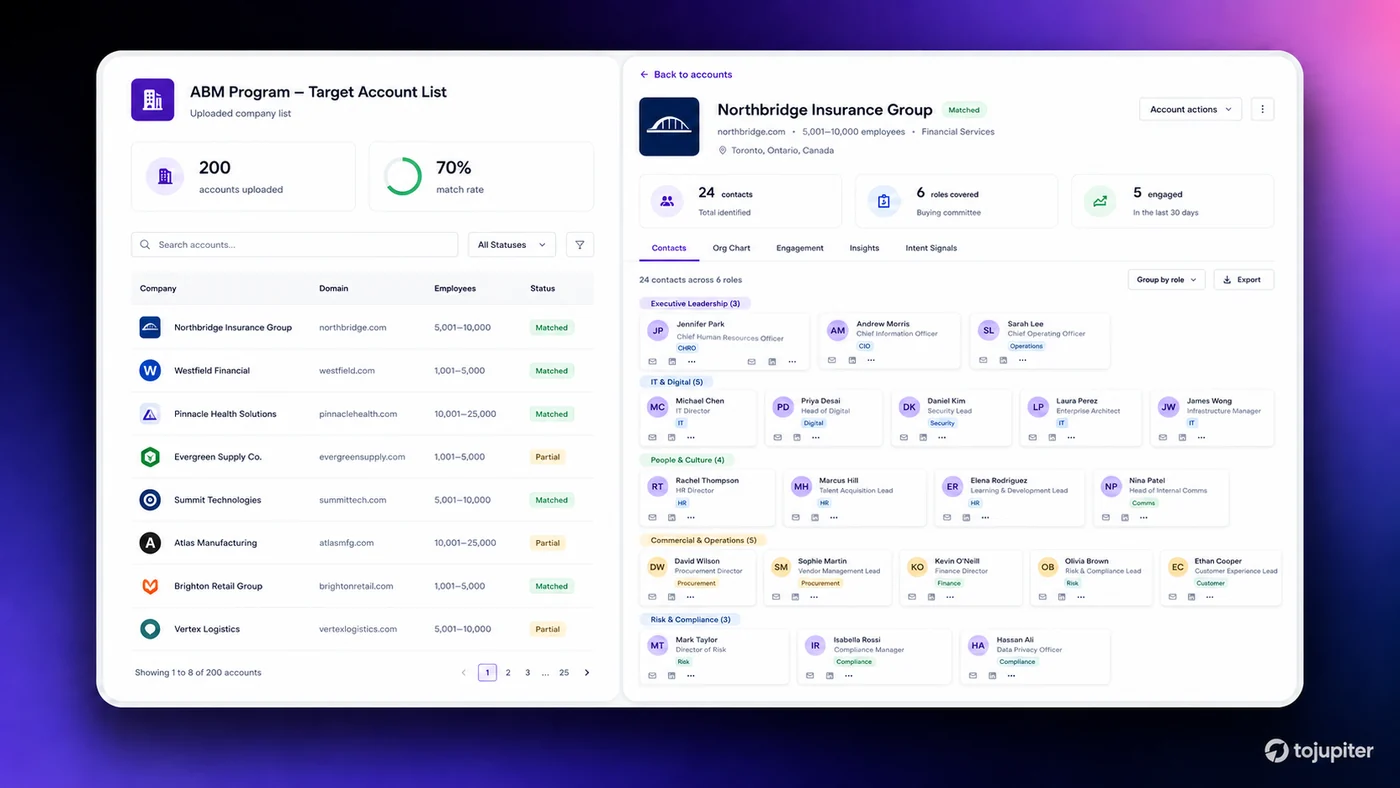
Because a company list tells LinkedIn which logos to match, and nothing about who inside those logos you can actually reach. You upload 200 target accounts. LinkedIn matches maybe 70% of them. Inside each matched account it serves your ad to whoever fits the job-title filter and happens to be scrolling. You have no idea whether that is the economic buyer, a graduate two years into the wrong department, or nobody at all this month.
I have seen this dashboard many times. Spend pacing nicely, impressions healthy, a click-through rate the client is proud of, and a pipeline number of zero. The account list was doing its job as a filter. It was never built to create coverage, so it didn't.
The company-list-and-go approach treats ABM as a media-buying decision. Real ABM is a data and access problem first. You cannot influence a buying committee you have not mapped, and you cannot map it from a spreadsheet of company names.
What does account coverage actually mean?
Account coverage is the share of a target account's buying committee you can identify, reach, and engage through your own channels. It has four layers, and you need all four before ads do anything useful.
Account enrichment. You start with a name and a domain. You finish with named people: their roles, seniority, email, LinkedIn profile, and where they sit in the org chart. Tools like Cognism, Clay, and Apollo turn a logo into a contact set. Without enrichment you are guessing at who matters.
Role coverage. A deal in mid-market SaaS rarely has one buyer. There is a champion, an economic buyer, a technical evaluator, a few blockers, and whoever owns the budget line. Role coverage measures whether you have a real contact against each seat at the table. One Head of Internal Comms is not role coverage. That person plus the CIO, the CHRO, and the IT director starts to be.
Marketing permission. A contact you cannot email or retarget is a name in a database, not a reachable person. Coverage counts contacts you have consent to market to, or a compliant route to reach them through matched audiences and outreach. GDPR makes this non-negotiable in the UK and EU. That legal line is where most paper ABM strategies fall apart.
Engagement depth. Reach is not the same as traction. Engagement depth tracks how many people inside an account have actually done something: opened a sequence, downloaded the guide, attended the dinner, replied to the question you asked them. An account with 20 mapped contacts and zero engagement is still cold. Coverage is only real once depth starts climbing.
Why can't you reach an account with one known contact?
Because one contact is one illness, one holiday, and one resignation away from a dead deal. Gartner's research puts a typical B2B buying committee at 6 to 10 people, each arriving with their own information and their own veto. When your entire presence inside an account rests on a single champion, you are betting the deal on a person who does not control the budget and may not survive the next reorg.
Single-threaded deals are the ones that stall in "closed lost, no decision." The champion goes quiet and you have no second line into the account. You never spoke to finance, so the business case never got built where it needed to. You never reached IT, so the security review ambushed you in week nine.
Multi-threading fixes this, and multi-threading is impossible without coverage. You cannot reach three stakeholders you have not mapped and enriched. The single contact is where ABM starts. Treating it as where ABM ends is the mistake.
The account coverage ladder
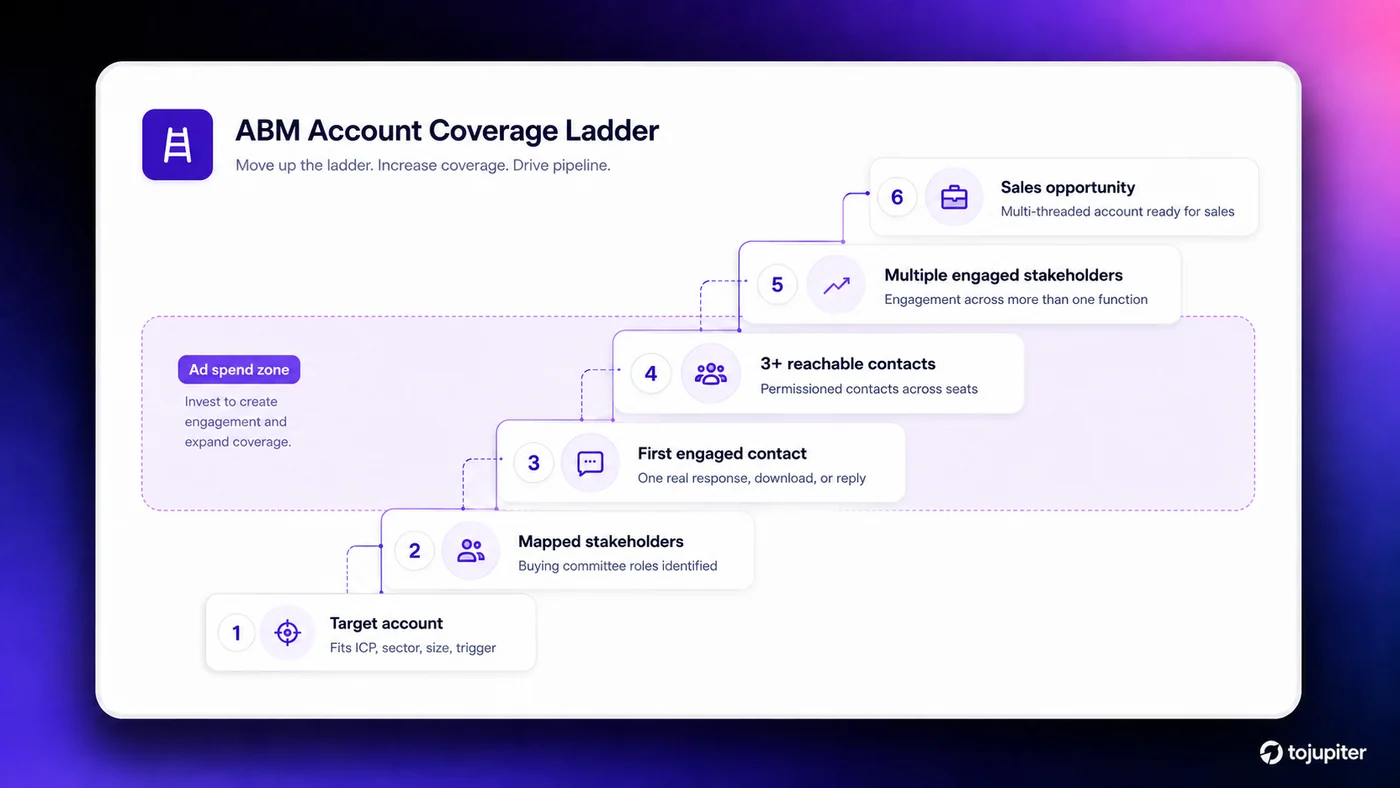
The account coverage ladder is a six-rung model for turning a target account into a sales opportunity. Each rung is a gate. You do not scale spend on an account until it has cleared the rung below.
- Target account. The account is on the list because it fits the ICP: right size, right sector, a real trigger. This is where most teams start and stop.
- Mapped stakeholders. You have identified the buying committee by role. You know the seats even before you have the names in them.
- First engaged contact. One person inside the account has done something real. A download, a reply, a demo request. You have a way in.
- Three or more reachable contacts. You have enriched, permissioned contacts against three or more seats on the committee. Now you can multi-thread.
- Multiple engaged stakeholders. More than one person across more than one function is engaging. The account is warming from several directions at once.
- Sales opportunity. The account has enough coverage and enough heat for sales to run a real, multi-threaded deal.
Ads belong at rungs three, four, and five, where they compound coverage you already built. Point them at a rung-one account and they burn budget on strangers who forget you before the deal cycle begins.
How do you take an account from one contact to 15-30 reachable people?
You enrich the account against a defined buying committee, then earn permission to reach each seat. This is the work we do by hand on live accounts, and it is the part a company-list upload skips entirely.
Here is the shape of it on a real account. Start: a 4,000-person insurance group, one known contact, a Head of Internal Comms who downloaded a guide. That is rung three, a single engaged contact and nothing behind it.
Map the committee. For a platform deal at that size the seats are CHRO, CIO, IT Director, Head of Digital, Internal Comms lead, and someone in procurement. Six seats, one name.
Enrich against those seats. Running the account through Cognism and Clay returns named people with roles, work emails, and LinkedIn profiles. The org chart fills in. That single contact becomes 22 relevant people, tagged by function and seniority.
Check permission. Some of those 22 are already in the CRM with marketing consent. The rest you reach through a LinkedIn matched audience and targeted outreach rather than cold email, which keeps the whole thing compliant.
One contact to 22 reachable people. That is the raw material. Turning it into engagement is the next job, and it takes more than a boosted post.
How do you turn reachable contacts into engaged ones?
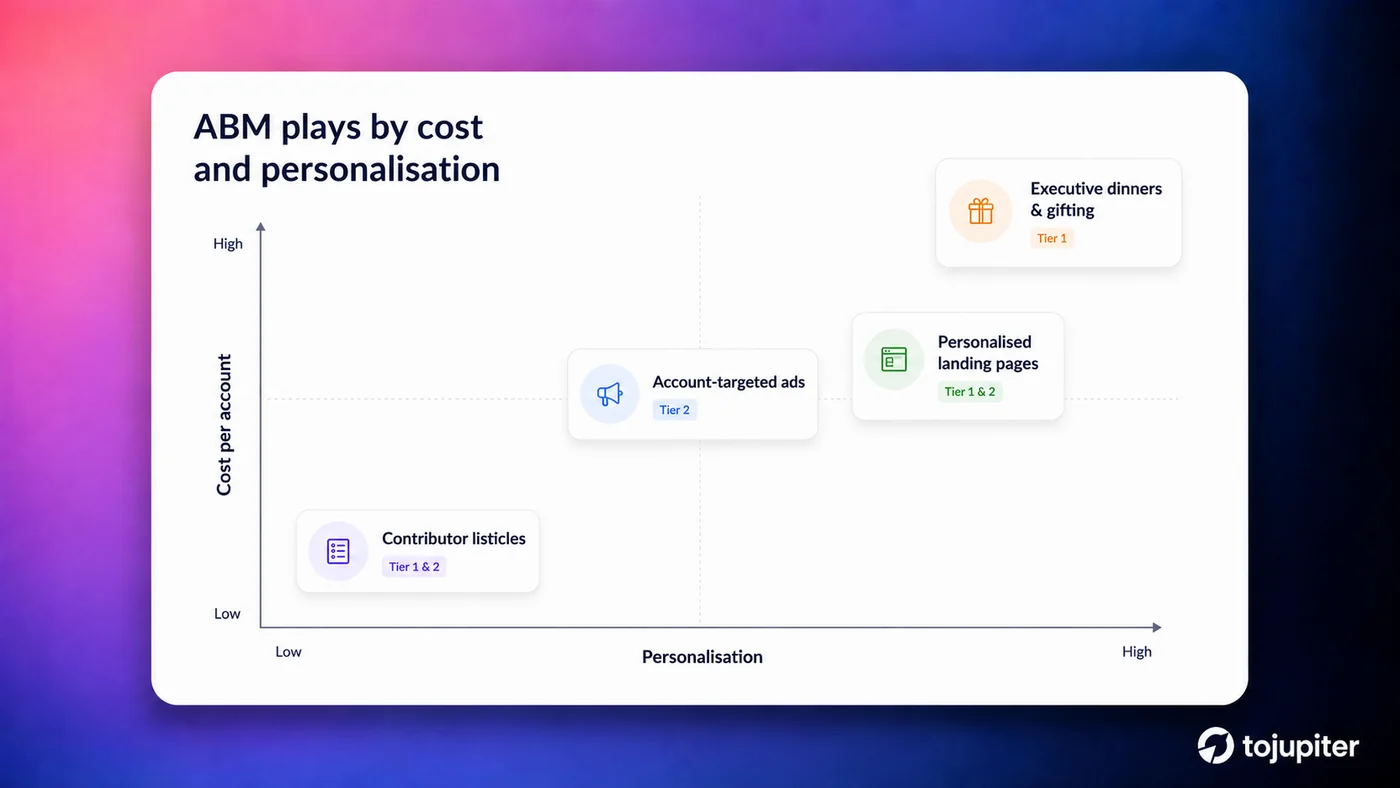
You match the play to what the account is worth, and you run from cheap and repeatable up to expensive and personal. Once a committee is mapped and reachable, ads are one option among several, and rarely the one that moves a Tier 1 account. Here are four plays we run, in rough order of cost per account.
Personalised landing pages. Build the page for the account, not the market. For an enterprise SEO testing platform, we ran landing pages that named the prospect's own site and showed what a test would look like on their category pages. A generic demo page greets a stranger. A page that reflects the account back to itself converts a committee that has started paying attention. The build cost is real, so you run it for named Tier 1 and Tier 2 accounts, not the whole list.
Account-targeted ads through an ABM platform. For a community engagement platform, we run account ads through ZenABM rather than a raw LinkedIn list, so spend lands on the mapped committee and reports at the account level instead of the impression level. This is the repeatable middle: cheaper than a dinner, warmer than a boosted post, and measurable against the accounts you actually care about.
Contributor listicles. Invite a prospect to answer one question, then publish them. For a community engagement platform that sells to HR and internal comms leaders, we built a "most influential internal comms leaders" piece and asked each named person to contribute a single line. The ask is small, so the reply rate is high. Every contributor then has a reason to share the piece to the exact audience you want to reach. One question turns a cold name into an engaged contact and a distribution channel at the same time.
Executive dinners and personalised gifting. At the top of the ladder, for a handful of Tier 1 accounts, the play is a dinner or a gift built for one person. A dinner with six mapped stakeholders in one city does more for a seven-figure account than a quarter of ads. It puts the committee in a room together and hands sales a warm follow-up with every seat. Gifting works the same way when it is specific to the person and sent with a reason, not a branded mug posted to a mailing list. These plays are expensive and they do not scale, which is the point. You run them only on accounts whose coverage and value justify the spend.
The pattern underneath all four: the more an account is worth, the more personal and the less repeatable the play. Cheap plays keep a wide set of accounts warm. Expensive plays win the few that matter. Run a personalised page and an account-ad programme across your Tier 2 list, save the dinners and the gifting for the Tier 1 names, and let the question-led listicle warm both at once.
Back to the insurance account. Over a few weeks, the CIO clicks through a landing page built around their own site, two HR leaders reply to the internal-comms listicle, and the CHRO accepts a dinner invite. Five people across three functions are now engaged. That is rung five. Sales inherits a multi-threaded account with warm contacts on the committee, not a lone champion and a hope.
How do you measure account coverage?
You measure it per account, not per campaign, with three numbers that a normal LinkedIn or Google dashboard will never show you.
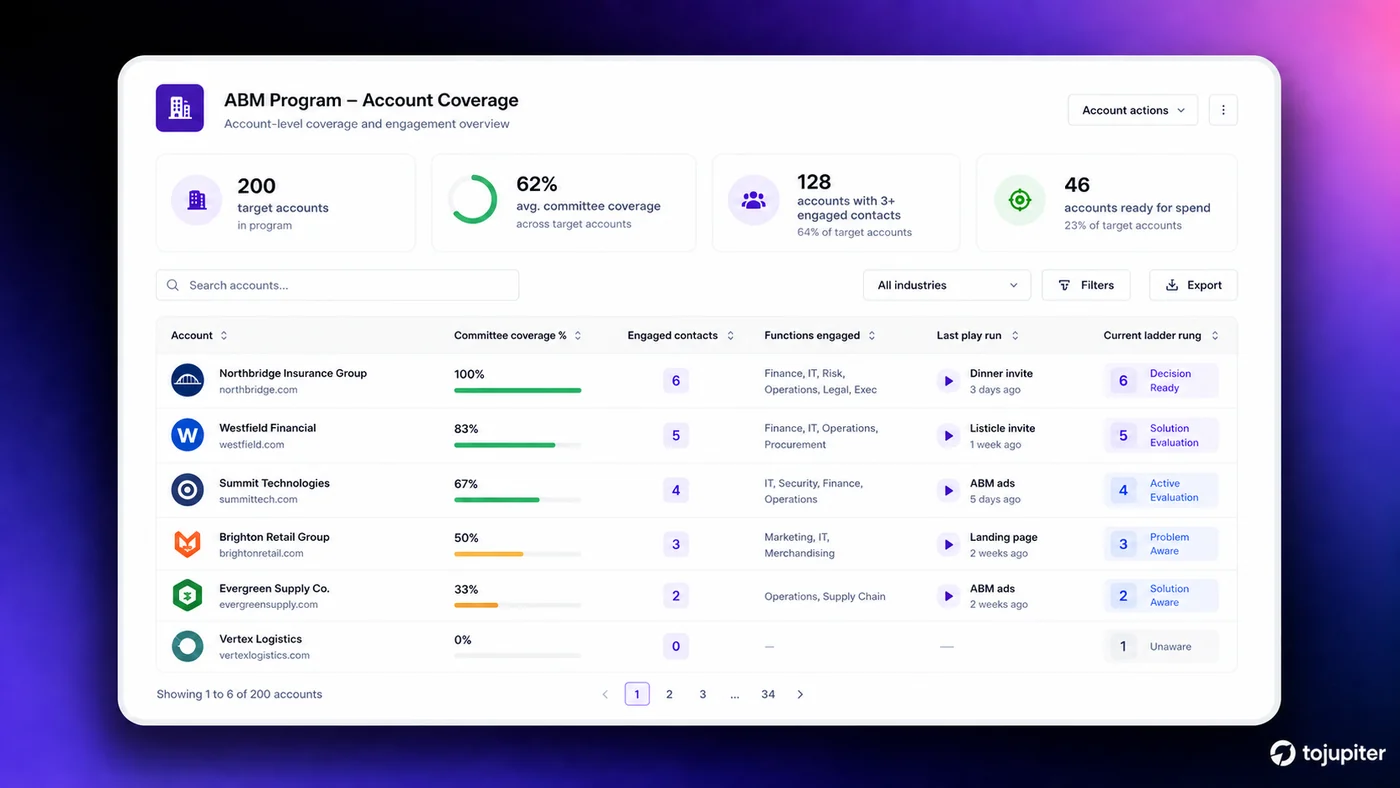
Committee coverage. Reachable contacts as a share of mapped seats. Six seats, four with permissioned contacts, is 67% coverage. This tells you where the holes are before sales hits them.
Engaged contacts per account. The count of people inside the account doing something, not impressions. One is a lead. Three or more across functions is an account worth a rep's time.
Multi-threading depth. How many distinct functions are engaged. An account with five engaged people all in IT is still single-threaded in disguise. Five people across IT, HR, and finance is a real deal.
Track these in the CRM or an ABM platform, not the ad account. LinkedIn reports on media. It has no concept of whether an account is one resignation from going cold. You have to build that view where your account data lives.
Where ads actually fit
Ads are an accelerant for coverage you already have. They are worthless as a substitute for it. Point paid media at an account with mapped stakeholders, permissioned contacts, and early engagement, and every impression lands on someone you meant to reach and reinforces a story they have started to hear. Point the same budget at a raw company list and you rent attention from people who will never remember your name. You report it with a metric that cannot predict a single deal.
The teams who win with ABM build coverage first, then pick the play that fits each account: a personalised page here, an account-ad programme there, a dinner for the names that justify it. The teams who upload a list and boost the budget are running display advertising with an account-based label on it. The account with one known contact was never the target. It was the starting line.


